What Is the Safest Way to Invest a $20,000 Windfall When You Have No Investing Experience and Still Carry Credit Card Debt?
Pay off high-interest debt first, build a small cushion, then invest the rest in a low-cost index fund. Here's exactly how to split the money.
Short answer
Before investing a single dollar in the market, pay off any high-interest credit card debt — zeroing a 22% APR card is a guaranteed 22% return that no beginner investment can reliably beat. Once the debt is gone, park the remainder in a high-yield savings account while you spend 30–60 days learning the basics, then put what's left into a low-cost total-market index fund. The order — debt first, emergency cushion second, index funds third — is boring on purpose, because boring is what keeps windfalls intact.
Money you did not earn through a regular paycheck feels psychologically strange. An inheritance, a bonus, a settlement — it arrives fully formed and seems to belong to a different version of you. That feeling is exactly what gets people into trouble, because money that feels unreal is money you spend without quite noticing.
The safest thing you can do in the first 48 hours is nothing. Do not wire it anywhere. Do not tell twelve people. Just let it sit while you make a plan.
Paying Off a 22% Card IS Investing
Most people assume investing means the stock market. It does not. Investing means deploying money to get a return. When you pay off a credit card charging 22% APR, you have just earned a guaranteed 22% return — no volatility, no brokerage account required. The S&P 500 averages roughly 10% annually over long periods, and that average includes brutal down years. Leaving $8,000 on a 22% card while putting $8,000 in an index fund means you are effectively borrowing at 22% to invest at an expected 10%. That is a guaranteed net loss on that portion of your money.
The Three-Bucket Rule — In This Exact Order
Think of your windfall as water poured through three stacked buckets. The first has to fill before anything reaches the second, and the second before anything reaches the third. There is no skipping.
- Bucket one: pay off all high-interest debt — credit cards, store cards, anything above roughly 8% APR. This is your highest-return investment.
- Bucket two: build or top up your emergency fund — three to six months of essential expenses in a high-yield savings account, untouched.
- Bucket three: whatever is left goes into a low-cost total-market index fund, ideally inside a Roth IRA if you qualify, or a standard brokerage account if not.
A Worked Example: $20,000 Split Three Ways
Say you received $20,000 and carry $8,000 across two credit cards — one at 24% APR, one at 19%. You have about $900 saved, which covers almost nothing in an emergency.
- $8,000 → wipe both cards completely. You have just permanently eliminated roughly $1,760 per year in interest charges.
- $4,000 → emergency fund in a high-yield savings account. At current rates of 4–5%, it earns something while it waits. More importantly, it is the buffer that keeps you from reaching for a credit card the moment your car needs a repair.
- $8,000 → total-market index fund. I would open a Roth IRA at Fidelity or Vanguard first — the 2025 contribution limit is $7,000 — and put the remaining $1,000 in a taxable brokerage account. Left alone for 25 years at a 9% average return, that $8,000 grows to roughly $69,000 without ever picking a single stock.
Five Windfall Mistakes Worth Naming
- The YOLO crypto move. Someone who made money in crypto will find you within days of your windfall becoming known. Crypto can be a small speculative position for experienced investors. It is not the right primary vehicle for money you cannot afford to lose.
- Lending to friends and family. Informal loans are almost never repaid in full, and they damage relationships. If you want to help someone, make it a defined gift you can afford to never see again.
- 'I'll invest after one vacation.' The vacation becomes two weeks away, a new wardrobe, and $4,000 gone. Take a modest, budgeted celebration — a nice dinner, a weekend trip — and cap it at a fixed amount before you deploy the rest.
- Asking the wrong people. Your cousin who does well in stocks is not your advisor. If you want professional guidance, a fee-only fiduciary financial advisor charges by the hour and is legally required to act in your interest.
- Waiting indefinitely to 'learn more.' The 30-day parking rule below is for active learning, not endless delay. Money sitting in a regular checking account at 0.01% while you think about it is slowly losing ground to inflation.
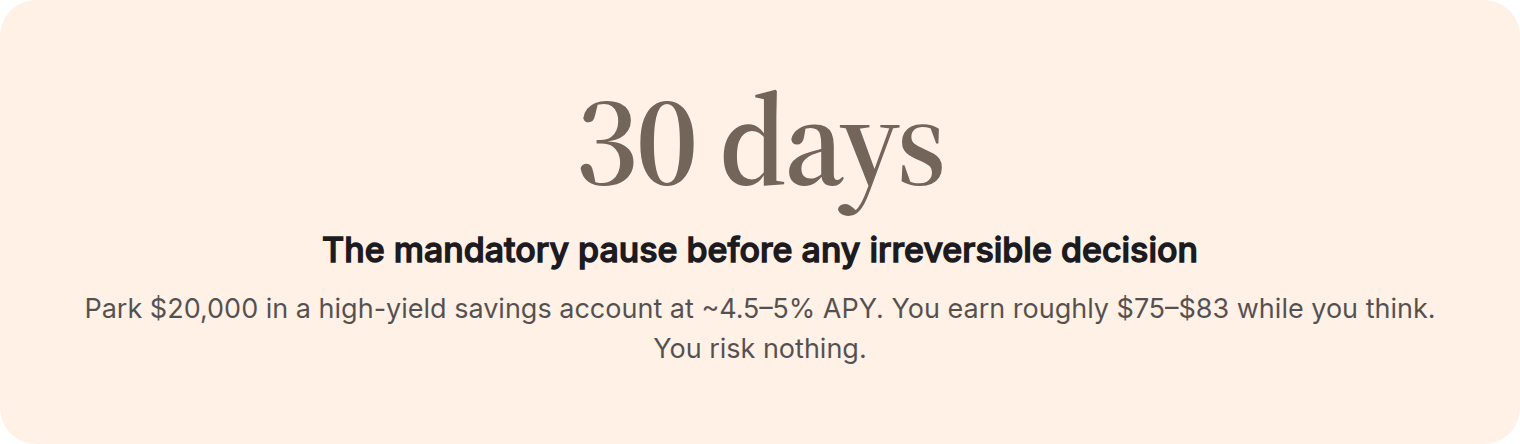
The 30-Day Parking Rule
After paying off debt and setting aside the emergency fund, the investing portion does not have to go into an index fund tomorrow. Move it to a high-yield savings account — Fidelity, Ally, and Marcus are all straightforward to open online. At 4–5%, your $8,000 earns roughly $27 a month while you get oriented.
Use that month deliberately. Read JL Collins' 'The Simple Path to Wealth' or his free blog version. Open a Roth IRA but do not invest yet — just get the account open and look around. Thirty days of focused learning beats six months of anxious Googling while the money sits untouched.
The best financial plan is the one you can actually follow without panicking every time the market drops 8% in a week. Boring and consistent beats brilliant and erratic every time.
Your Literal Next Three Steps This Week
- Today: log into every credit card account, write down the exact balance and APR for each one, and total them. You cannot build a plan around a vague number.
- Within 3 days: move the windfall into a high-yield savings account, away from your daily spending money. Most transfers take one to three business days.
- By end of this week: pay off your highest-APR card in full, then the next. If the total debt is smaller than the windfall, zero all of it. If it is larger, pay down as much as you can starting from the highest rate.
You will feel oddly flat after paying off the cards. There is no confetti. But the next time a statement arrives and it says $0.00, something shifts — and that feeling is worth more than the return on your first investment.
Questions people also ask
Should I pay off student loans before investing too?
It depends on your interest rate. Federal student loans often carry rates between 4–7%, low enough that investing at the same time makes reasonable sense. Credit cards at 18–28% are a different situation — those come first, always.
What if I have no credit card debt at all? Where does all $20,000 go?
First confirm your emergency fund covers 3–6 months of essential expenses. Then max out a Roth IRA ($7,000 for 2025 if you qualify) and put the rest into a taxable brokerage account invested in a total-market index fund. If your employer offers a 401(k) match, contribute enough to capture it before doing anything else — that match is an instant 50–100% return.
What exactly is a total-market index fund and why that instead of picking stocks?
A total-market index fund buys tiny slices of thousands of companies at once, so your money tracks the whole market rather than betting on individual businesses. Evidence consistently shows that most professional fund managers underperform simple index funds over a decade. Common low-cost options include VTSAX, FSKAX, and SWTSX.
How do I handle taxes on a windfall?
It depends on the source. Inheritances are generally not taxable income to the recipient in the US. Lawsuit settlements depend on what they compensate for. Bonuses are taxed as ordinary income. If you are unsure, one hour with a CPA is worth far more than guessing.
Is a Roth IRA better than a regular brokerage account for a beginner?
For most people in their 20s and 30s, yes — contributions are after-tax, but growth and qualified withdrawals are tax-free. The main limits are the $7,000 annual cap and income phase-outs that begin around $146,000 for single filers in 2025.
The Full Guide
Turn Your $20K Windfall Into Wealth — Not Regret
- A printable three-bucket worksheet where you enter your exact balances and APRs to get a personalized split in minutes
- Three fully worked scenarios — small debt, large debt, and zero debt — with projected 10- and 25-year outcomes for each
- A 30-day learning checklist with specific free resources, account setup steps, and a week-by-week schedule so the learning period ends with money actually invested