
What Do I Do With This Money? cover
The full guide · 22 pages · PDF

What Do I Do With This Money?

A plain-English guide to investing a $20,000 windfall when you have credit card debt and zero investing experience

Before investing a single dollar in the market, pay off any high-interest credit card debt — a 22% APR card is a guaranteed 22% return the moment you zero the balance, which no beginner investment can reliably beat. Once the debt is gone, park the remainder in a high-yield savings account while you spend 30–60 days learning the basics, then open a low-cost index fund account with whatever is left. This order — debt first, emergency cushion second, index funds third — is boring on purpose, because boring is what keeps windfalls intact.

Get the guide — free

What's inside

01
The Windfall Psychology Trap
Sudden money feels psychologically different from earned money — your brain is not broken, but it needs a speed limit imposed on it.
02
Debt Triage: Your Guaranteed Return
Paying off a 22% APR credit card is a 22% guaranteed, tax-free return. No beginner investment reliably beats that.
03
Three Scenarios: Where Does Your $20,000 Actually Go?
With $15,000 in card debt, wipe the debt first and park $5,000 as an emergency fund. Zero left to invest — but you just saved ~$3,300 a year in interest.
04
Index Funds for Actual Beginners
An index fund owns hundreds or thousands of companies at once. You capture market growth without picking individual stocks — and without paying someone to try.
05
The 12-Month Windfall Calendar
Treat the windfall as a 12-month process, not a single decision. Each month has a specific, limited set of actions — do not skip ahead.
06
Mistakes, Regrets, and Recovery
If you already spent some of the windfall, your starting number is whatever you have left. Work the same plan with a smaller number — it still works.
07
The Short Version: What I'd Actually Do
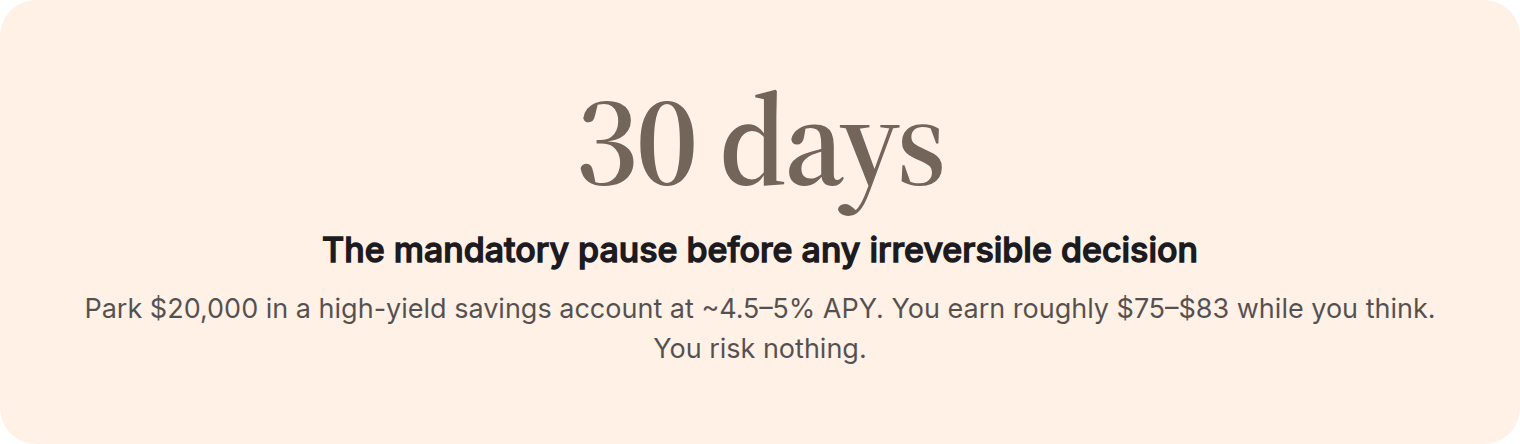
The whole plan fits in three sentences: park it for 30 days, kill high-rate debt, invest the rest in a single low-cost index fund inside a Roth IRA.

Plus 2 fill-in worksheets and a 12-step action checklist.

A page from the guide
Infographic from the guide

Who it's for

A financially inexperienced adult who has just received an unexpected lump sum — inheritance, bonus, lawsuit settlement, or tax refund — and feels equal parts excited and terrified about not wasting it. They are holding $20,000 they did not expect to have, and they have never invested before, so every option feels risky or confusing. They still carry credit card debt — probably $3,000–$12,000 — and are unsure whether paying it off is 'investing' or just being boring. Their core fear is making one bad decision that destroys the windfall and leaves them worse off than before they got it.

Questions

Should I pay off student loans before investing too?
It depends on your interest rate. Federal student loans often carry rates between 4–7%, low enough that investing at the same time makes reasonable sense. Credit cards at 18–28% are a different situation — those come first, always.
What if I have no credit card debt at all? Where does all $20,000 go?
First confirm your emergency fund covers 3–6 months of essential expenses. Then max out a Roth IRA ($7,000 for 2025 if you qualify) and put the rest into a taxable brokerage account invested in a total-market index fund. If your employer offers a 401(k) match, contribute enough to capture it before doing anything else — that match is an instant 50–100% return.
What exactly is a total-market index fund and why that instead of picking stocks?
A total-market index fund buys tiny slices of thousands of companies at once, so your money tracks the whole market rather than betting on individual businesses. Evidence consistently shows that most professional fund managers underperform simple index funds over a decade. Common low-cost options include VTSAX, FSKAX, and SWTSX.
How do I handle taxes on a windfall?
It depends on the source. Inheritances are generally not taxable income to the recipient in the US. Lawsuit settlements depend on what they compensate for. Bonuses are taxed as ordinary income. If you are unsure, one hour with a CPA is worth far more than guessing.
Is a Roth IRA better than a regular brokerage account for a beginner?
For most people in their 20s and 30s, yes — contributions are after-tax, but growth and qualified withdrawals are tax-free. The main limits are the $7,000 annual cap and income phase-outs that begin around $146,000 for single filers in 2025.