Where Should Beginners Invest Money to Get Good Returns? cover
The full guide · 36 pages · PDF

Where Should Beginners Invest Money to Get Good Returns?

A plain-English guide for first-time investors who want to do something smart with their savings without making a costly mistake

For most beginners, the best starting point is a low-cost index fund inside a tax-advantaged account like a Roth IRA or a workplace 401(k). Index funds spread your money across hundreds of companies automatically, which reduces risk without requiring you to pick stocks. A total market or S&P 500 index fund from a provider like Vanguard, Fidelity, or Schwab is a solid, evidence-backed choice. Start with whatever you can afford, even $25 a month, and increase it over time.

Get the guide — free

What's inside

01
The Beginner's Investing Roadmap: Where You Are Now and What Each Stage Looks Like
Before investing, make sure you have no high-interest debt and at least one month of expenses saved as an emergency fund.
02
Account Types Decoded: Roth IRA, Traditional IRA, 401(k), and Taxable Accounts Side by Side
The account is a container, not an investment. The Roth IRA, 401(k), and taxable account just determine how taxes work; what you put inside them is a separate decision.
03
Index Funds vs. ETFs vs. Stocks vs. Savings Accounts: A Plain-English Comparison
A savings account is a parking spot, not an investment. Use it for your emergency fund and money you will need within two years.
04
Worked Scenario 1: Investing $50 a Month on a Tight Budget
$50 a month invested consistently at 7% becomes over $60,000 in 30 years; more than two-thirds of that is growth, not money you contributed.
05
Worked Scenario 2: Investing a $2,000 Lump Sum with Monthly Additions
A $2,000 lump sum invested immediately, combined with $100 per month ongoing, grows to over $121,000 in 30 years at a 7% return, with only $38,000 contributed out of pocket.
06
Step-by-Step Account Setup: Fidelity, Schwab, and Vanguard
Opening a Roth IRA at Fidelity, Schwab, or Vanguard takes 15 to 20 minutes and can be done entirely online with your Social Security number and bank account details.
07
The Set and Forget Portfolio Template: One or Two Funds That Cover the Whole Market
A one-fund portfolio (total U.S. market index) or two-fund portfolio (80% U.S. and 20% international) is genuinely sufficient for most investors at any stage.
08
Risk, Fear, and Market Dips: Staying Calm When the Numbers Drop
The biggest risk for a beginner is not the market drop itself; it is selling during the drop and converting a temporary paper loss into a permanent real loss.

Plus 1 fill-in worksheet and a 12-step action checklist.

A page from the guide
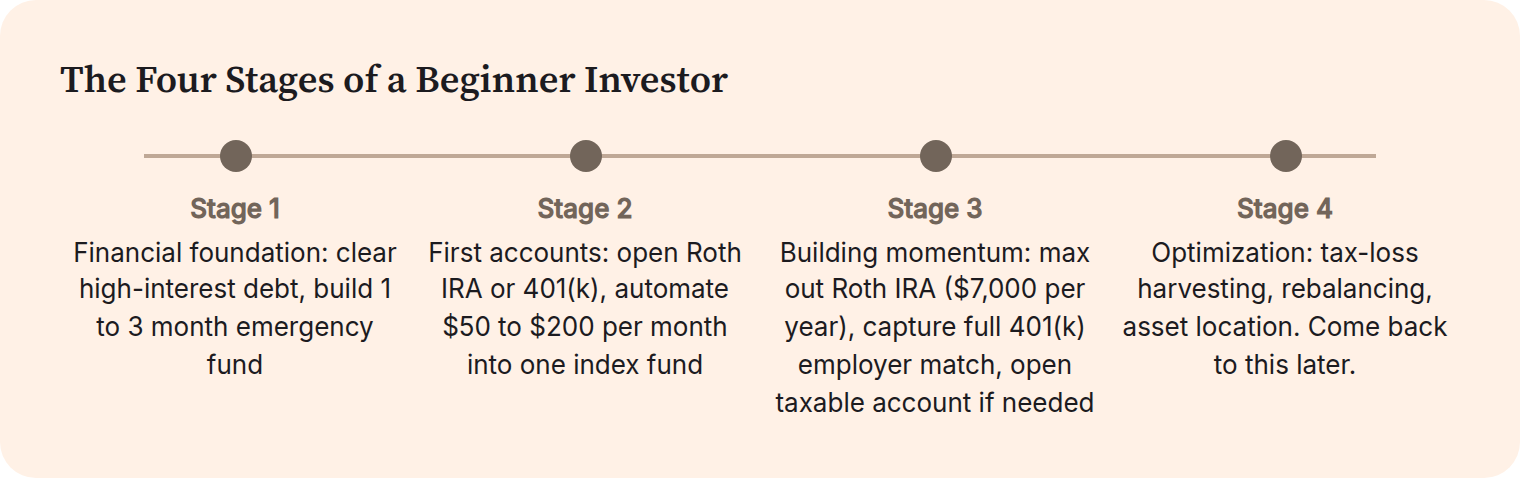
Infographic from the guide

Who it's for

A first-time earner in their 20s or 30s who has saved a small amount of money and feels overwhelmed by investing options they don't fully understand. They have some money sitting in a low-interest savings account and feel a nagging sense that they should be doing something smarter with it, but they don't know where to start without making a costly mistake. They are worried about losing what little they have saved, being tricked by bad advice, or picking the wrong thing and falling behind financially.

Questions

How much money do I need to start investing?
Fidelity and Schwab have no minimum to open a Roth IRA, and some of their index funds let you buy in for $1. You don't need a large sum. Starting with $25 or $50 a month beats waiting until you have 'enough.'
Is a Roth IRA better than a traditional IRA?
For most people in their 20s and 30s who expect their income to grow, yes. You pay taxes on the money now at a lower rate, and all future growth comes out tax-free in retirement. If you're in a very high tax bracket now, a traditional IRA might be worth comparing.
What if my employer doesn't offer a 401(k)?
Open a Roth IRA directly with Fidelity, Schwab, or Vanguard and contribute there. Self-employed? A SEP-IRA or Solo 401(k) lets you contribute much larger amounts and is worth looking into.
Should I pay off debt before investing?
High-interest debt—anything above roughly 7% interest, like credit cards—should generally be paid off before investing outside of your employer match. Lower-interest debt like student loans or a car loan at 4% is a closer call, and many people do both simultaneously.
What happens to my investment if the company I invest through (like Fidelity) goes bankrupt?
Your investments are held separately from the brokerage's own assets and protected by SIPC insurance up to $500,000. A brokerage going bankrupt doesn't mean your investments disappear—they're yours, not theirs.