
Paying Off Medical Debt and Credit Card Debt at the Same Time cover
The full guide · 26 pages · PDF

Paying Off Medical Debt and Credit Card Debt at the Same Time

A Plain-English Plan for When Your Bills Come From Two Different Worlds

Start by separating the two debt types because they behave differently: medical debt rarely accrues interest and is now largely removed from credit reports, while credit card debt compounds daily and directly damages your score. Call your medical provider first to negotiate a zero-interest payment plan or hardship reduction, then apply the avalanche or snowball method to your credit cards with whatever is left in your budget. List every balance, minimum, and interest rate in one place, assign each dollar a job, and review the plan monthly. Paying something — even $25 — on each debt keeps accounts in good standing while you build momentum.

Get the guide — free

What's inside

01
Understanding the Rules: How Medical Debt and Credit Card Debt Differ Legally and Financially
Medical debt and credit card debt have different legal frameworks — understanding both prevents panic and bad decisions.
02
The Master Inventory: A Fill-in Template to List Every Balance, Rate, and Collector
Write every balance, rate, and payment on one page. The act of listing removes the fog that makes debt feel bigger than it is.
03
Negotiating Medical Debt Down Before You Pay: Scripts, Hardship Applications, and What Hospitals Can't Say No To
Never pay a large medical bill at face value. Request the itemized version first, then apply for financial assistance before writing any check.
04
Choosing Your Credit Card Strategy: Avalanche vs. Snowball With Three Worked Scenarios
Avalanche saves more money; snowball provides faster wins. Neither works if you quit, so pick based on your own track record with discipline.
05
Building a Dual Payoff Calendar: Month-by-Month Tracker for Both Debt Types
A month-by-month payoff calendar turns vague intentions into specific targets. Write down the projected balance for each debt at the end of each month.
06
When Collections Are Already Involved: What to Do If Medical Bills Are in Collections or on Your Credit Report
Send a debt validation letter before paying any collections agency. It's your legal right under the FDCPA, and it ensures you're paying a real, valid debt.
07
Protecting Yourself While You Pay: Emergency Fund Minimums, Insurance Gaps, and the 90-Day Check-In
Build a $1,000 to $1,500 emergency buffer before sending extra money to debt. Without it, one car repair restarts the cycle — at the same 26.99% APR you're trying to escape.

Plus 2 fill-in worksheets and a 12-step action checklist.

A page from the guide
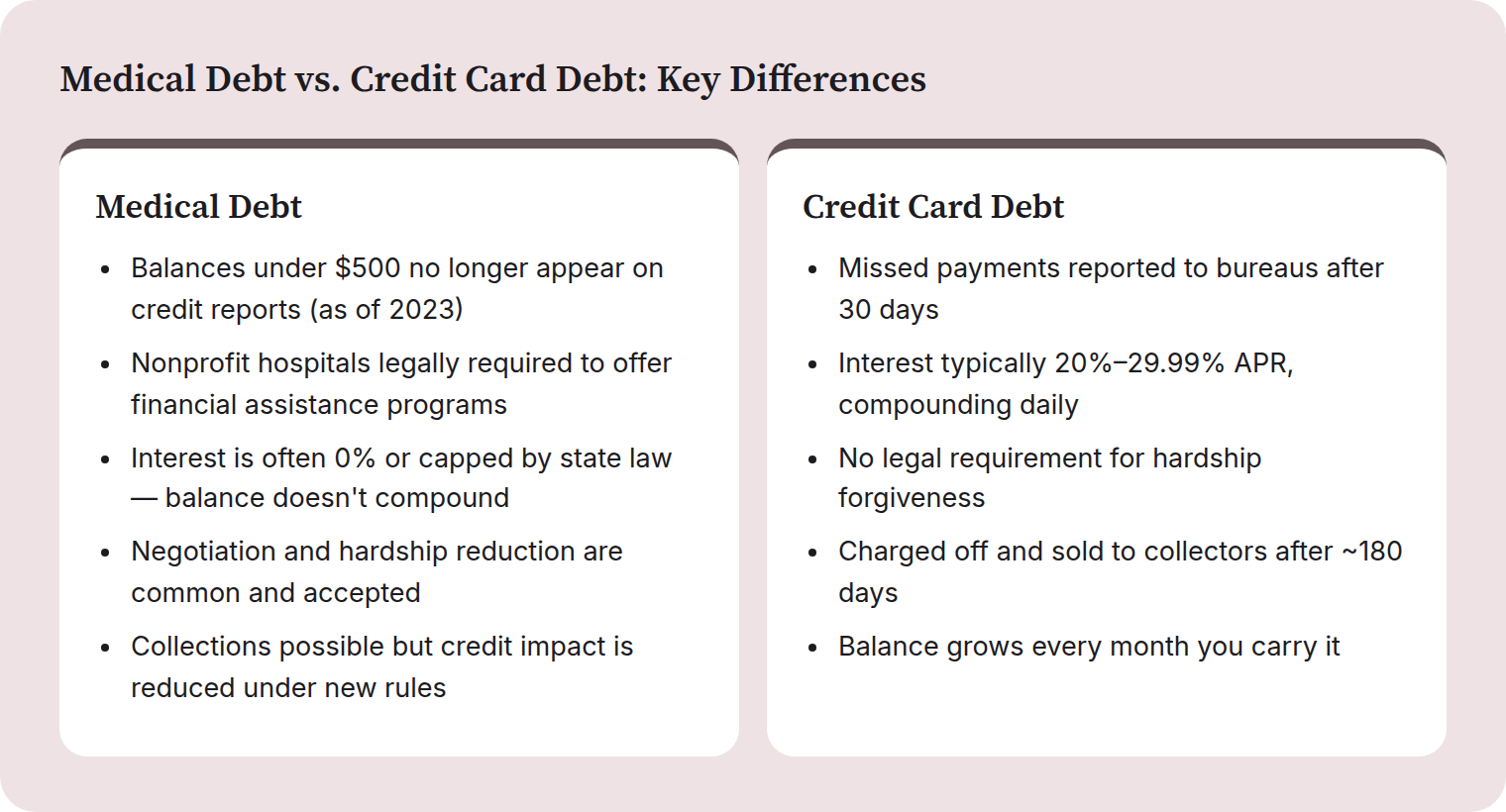
Infographic from the guide

Who it's for

An adult juggling unpaid hospital or clinic bills alongside revolving credit card balances, feeling overwhelmed by two different types of debt with different rules and different consequences. They may have had a surprise medical event — an ER visit, a surgery, or a chronic diagnosis — that left them with bills in collections or on a payment plan, while also carrying credit card debt they accumulated before or during that health crisis. They are worried about which debt to tackle first, whether ignoring medical bills will hurt their credit score the way ignoring credit cards does, and whether they can even afford to pay both at the same time. The two debts feel like they play by different rules, and that uncertainty is paralyzing them.

Questions

Will medical debt hurt my credit score if I don't pay it right away?
As of 2025, medical debt is largely removed from consumer credit reports, so it's unlikely to affect your score directly. However, a large unpaid balance sent to a third-party collector can still appear as a collection account, so staying in communication with the provider and keeping a payment plan active is the safer move.
Can I negotiate my credit card interest rate the way I negotiate a medical bill?
You can call and ask, and it occasionally works if you have a solid payment history. More reliably, major card issuers offer hardship programs that temporarily lower your rate or waive fees — ask specifically for the hardship or customer assistance department rather than the general line.
What if my medical bill is already in collections?
It's not too late. Medical debt collectors often accept less than the full balance, especially for a lump-sum offer. Start by asking if they'll settle for 50% and get any agreement in writing before sending money.
Should I drain my savings to pay off debt faster?
Keep at least one to two months of expenses in savings before going aggressive on debt — because one unplanned expense without a cushion usually means new credit card charges, which undoes the progress. Once you have that buffer, direct extra cash toward your highest-rate debt.
Does the order matter if my credit card interest rates are close to each other?
If the rates are within two or three percentage points, the math difference is small. In that case, the snowball method — smallest balance first — is probably the better call because eliminating a card entirely simplifies your monthly picture and builds momentum.