
The LLC Tax Structure Guide cover
The full guide · 22 pages · PDF

The LLC Tax Structure Guide

How to legally pay yourself a salary, cut your self-employment tax bill, and not lose sleep over the IRS

You reduce self-employment tax by electing S-corp tax treatment for your LLC, which lets you split your income into a reasonable W-2 salary and owner distributions — you only owe self-employment tax on the salary portion, not the distributions. To do this, you file IRS Form 2553 to elect S-corp status, run actual payroll for yourself at a salary the IRS would consider reasonable for your role, and take additional profit as distributions. This strategy typically saves money once your net profit is reliably above roughly $40,000–$50,000 per year, because below that the payroll administration costs can outweigh the tax savings. Done correctly it is fully legal and widely used, but you must pay yourself a genuinely reasonable salary or the IRS can reclassify your distributions and hit you with back taxes and penalties.

Get the guide — free

What's inside

01
Where Your Self-Employment Tax Actually Goes (And Why It Hurts So Much)
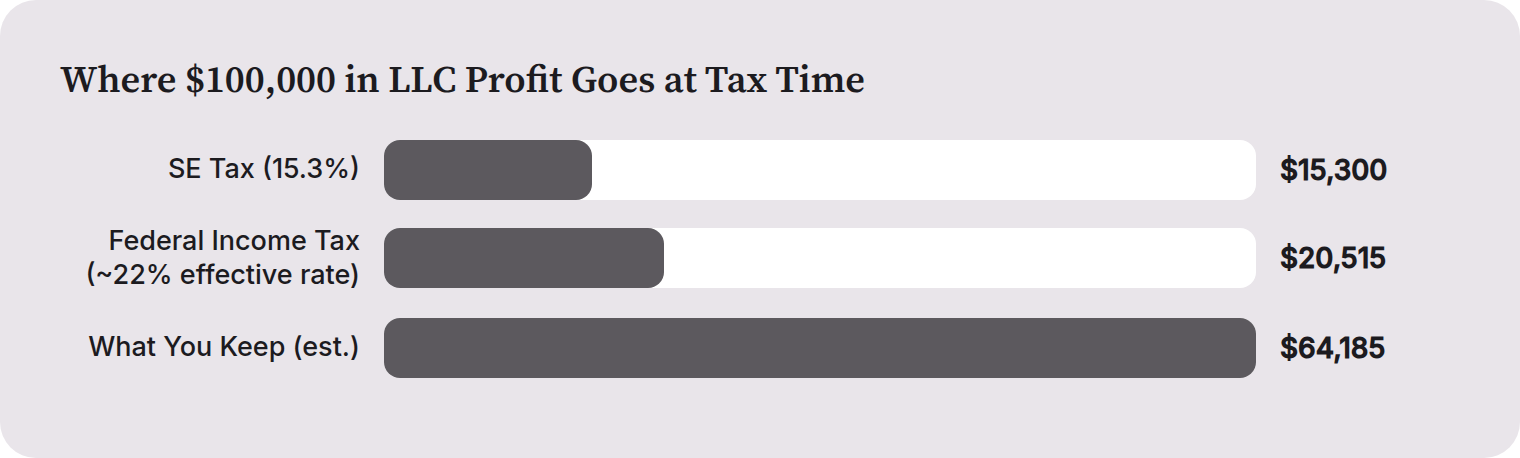
Self-employment tax is 15.3% on net profit — you pay both the employer and employee halves because you are both.
02
Single-Member LLC vs. S-Corp Election: What Actually Changes
You do not form a new entity — you file an election that changes how the IRS taxes your existing LLC.
03
Filing Form 2553: The Exact Steps and Deadlines You Cannot Miss
File by March 15 to have the election apply to the current calendar year. Missing this means waiting until next year.
04
Setting Your Reasonable Salary: What the IRS Expects and How to Find Your Number
Reasonable compensation means what you'd pay a qualified person to do your job — look it up on bls.gov/oes and document your reasoning.
05
Two Real Scenarios: Exactly What the Numbers Look Like
At $80,000 in profit, the S-corp election saves roughly $1,800/year after compliance costs — real but modest. Revisit when income grows.
06
Running Payroll for Yourself and Staying Compliant All Year
Use a payroll service — Gusto or QuickBooks Payroll costs roughly $600 to $700 per year and handles 941s, deposits, and W-2s automatically.
07
When the S-Corp Election Stops Making Sense — And How to Exit
Revoke the S-corp election if your income drops below $50,000 net, your state's treatment makes it punitive, or you need ownership flexibility that S-corps don't allow.

Plus 2 fill-in worksheets and a 12-step action checklist.

A page from the guide
Infographic from the guide

Who it's for

A self-employed freelancer, consultant, or small business owner who set up an LLC and is now realizing they are paying a painful amount in self-employment tax every year. They are running their business through a single-member LLC and writing a big check to the IRS each quarter, suspecting there is a smarter legal structure they are missing. They have heard vague things about S-corps and 'paying yourself a salary' but do not know if it applies to them, how to set it up, or whether it is worth the hassle. They are worried about doing it wrong, triggering an audit, or paying a professional thousands of dollars just to understand their options.

Questions

Can I make the S-corp election on an existing LLC or does it need to be a new one?
You can file Form 2553 on an existing LLC at any time. File by March 15 to have it apply to the current calendar year. The IRS also has a late-election relief procedure, but you are better off not relying on it.
Do I need to live in a state that recognizes S-corps for this to work?
Most states follow the federal election automatically, but some — including California and New York — impose additional franchise taxes or fees on S-corps. Check your state's treatment first, because in some cases the state-level cost changes whether the strategy is worth it.
What happens to my quarterly estimated tax payments after the S-corp election?
You still make quarterly payments, but the structure shifts. Payroll taxes are withheld from your W-2 salary and remitted on a regular schedule. You will still owe estimated income tax on your distributions, so quarterly payments continue for that portion. A CPA can help you set the right amounts to avoid underpayment penalties.
Can I still contribute to a Solo 401(k) after making the S-corp election?
Yes. With an S-corp, your employee contribution is based on your W-2 salary, and the business can make employer contributions on top of that. The key difference from a sole proprietorship is that your contribution limits are now tied to your salary rather than your full net profit, so the salary you set also affects how much you can put away.
Does the S-corp election increase my audit risk?
Not meaningfully, as long as you follow the rules — especially the reasonable salary requirement. S-corps are common and the IRS is familiar with them. Where people get into trouble is paying an obviously low salary or skipping actual payroll. Run the structure correctly and it is not an audit magnet.