How to Save Taxes on International Income cover
The full guide · 24 pages · PDF

How to Save Taxes on International Income

A plain-English guide for freelancers, expats, and small business owners earning across borders

The biggest legal levers are tax treaties (which prevent the same income being taxed twice), the Foreign Earned Income Exclusion if you are a US citizen abroad, strategic tax residency choices, and timing when income lands in which country. You do not need to hide money — most savings come from understanding which country has the right to tax which income, then structuring your affairs so you claim every treaty benefit and exclusion you are already entitled to. A cross-border tax professional plus a one-time residency review can routinely cut an expat or freelancer's bill by 20–40%. The rules are complex but the savings are real and fully above board.

Get the guide — free

What's inside

01
How International Tax Actually Works: Residency, Source Rules, and Who Gets to Tax What
Residency and source are the two levers every country uses to claim your income — understand both before anything else.
02
Tax Treaties Decoded: How to Read a Treaty Table and Claim the Benefit
Treaties cap withholding rates — but you must claim the benefit proactively, usually by filing a W-8BEN with your payer before they pay you.
03
The Foreign Earned Income Exclusion and Foreign Tax Credit — A Worked Example
The FEIE excludes up to $126,500 of foreign earned income in 2024 — if you qualify and are in a low-tax country, this is usually the better choice.
04
Freelancers and Remote Workers: Sourcing Income and Structuring Contracts
The US sources personal services income where the work is physically performed — non-US freelancers working abroad for US clients often owe no US tax if they file a W-8BEN.
05
Becoming Tax Resident Somewhere New: Day Counts, Departure Returns, and What to Do Before You Leave
Canada and Australia have deemed disposition rules that can trigger capital gains tax on unrealised gains — including on a $50,000 portfolio gain — the day you leave. Model this before your departure, not after.
06
Country-Pair Cheat Sheets: US–UK, US–Canada, US–Australia
The US–UK treaty reduces royalty withholding to 0% — file W-8BEN proactively, or lose 30% to default withholding and wait for a refund via Form 1040-NR.
07
Your Pre-Filing Checklist: 22 Questions and a One-Page Income Tracker
FBAR and FATCA are separate from your tax return and have their own deadlines and penalty structures — treat them as independent compliance tasks.

Plus 2 fill-in worksheets and a 12-step action checklist.

A page from the guide
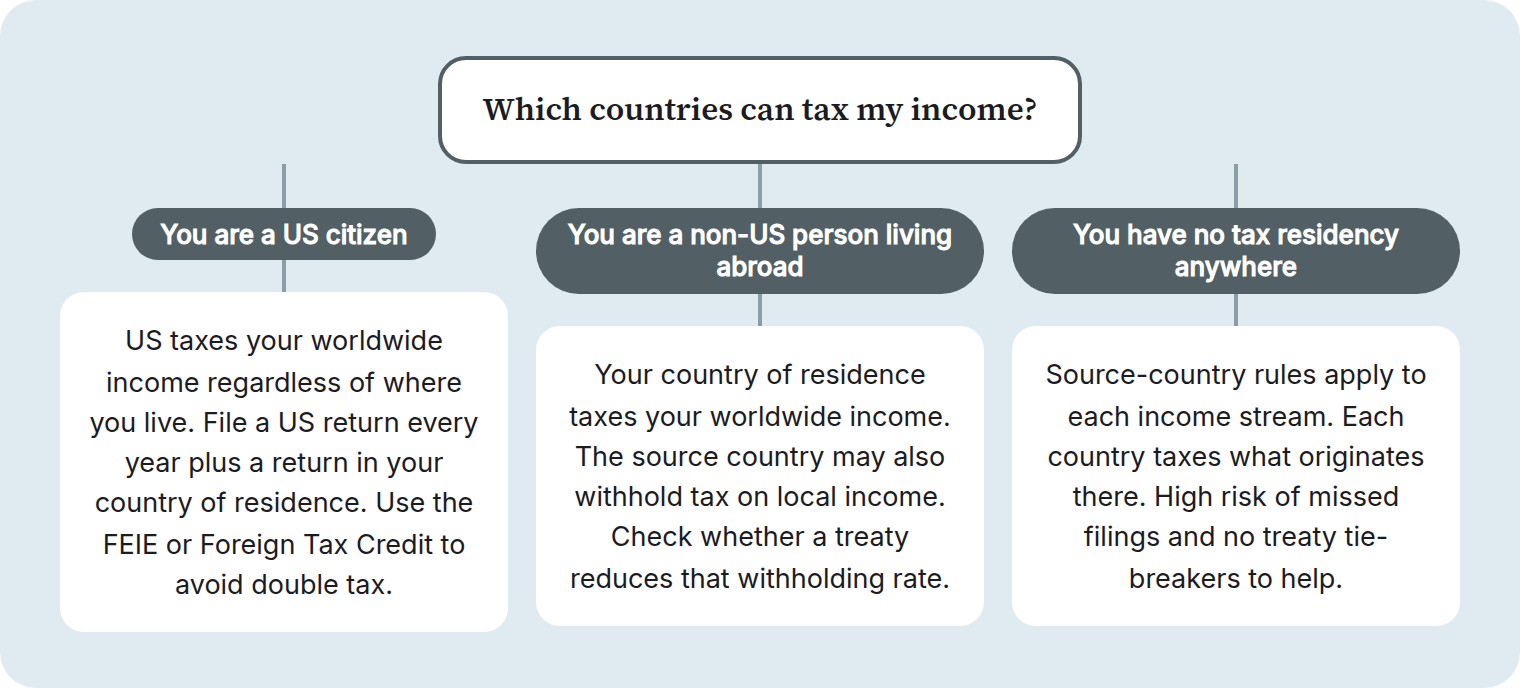
Infographic from the guide

Who it's for

A freelancer, remote worker, expat, or small business owner who earns income across more than one country and suspects they are paying too much tax but does not know where to start. They have income hitting bank accounts in multiple countries — client payments, rental income, a foreign salary, or a side business — and tax season feels like a guessing game. They are worried they are being taxed twice on the same money, missing deductions they are legally entitled to, or accidentally breaking rules they did not know existed. They want to keep more of what they earn without doing anything illegal.

Questions

Do I have to file a US tax return if I live abroad full time?
Yes. US citizens and green card holders must file a federal return regardless of where they live. The FEIE and Foreign Tax Credit can reduce or eliminate what you owe, but the filing obligation does not disappear because you moved.
Can I just become a tax resident of a low-tax country to avoid US tax?
Not if you are a US citizen — the US taxes based on citizenship, making it one of only two countries in the world to do so. Changing tax residency can significantly reduce your non-US tax burden, but it does not eliminate US filing obligations unless you formally renounce citizenship.
What is the difference between the Foreign Earned Income Exclusion and the Foreign Tax Credit?
The FEIE excludes a set amount of earned income from US taxable income — up to $126,500 in 2024. The Foreign Tax Credit offsets your US tax bill dollar-for-dollar by foreign tax already paid. They work differently, can sometimes be used together, but cannot both apply to the exact same dollars of income.
I have a foreign bank account with about $15,000 in it. Do I need to report it?
Yes. If the combined balance across all your foreign financial accounts exceeded $10,000 at any point during the year, you must file an FBAR (FinCEN Form 114) by April 15, with an automatic extension to October 15. It is filed separately from your tax return through a different system.
My employer withheld foreign income tax from my salary. Does that count toward the Foreign Tax Credit?
Generally yes — foreign income taxes withheld by an employer count toward the credit on Form 1116. Your foreign pay stub or employer tax summary should show the amount withheld.