How Do I Build a Weekly Financial Review System That Actually Stops Me from Overspending Each Month?
A 20-minute Sunday ritual beats every budgeting app you've abandoned. Here's the exact system that catches overspending before it becomes a monthly disaster.
Short answer
A weekly financial review works when it's short, scheduled, and triggered by a calendar event — not by motivation. Every Sunday, pull up one number: your spending so far that week, compared to a simple weekly target. Catching a $40 overspend on Wednesday is fixable; discovering a $200 blowout on the 31st is just painful.
Why Monthly Budget Reviews Always Fail
Here's the honest problem with reviewing your budget at the end of the month: by the time you see the damage, you can't do anything about it. You open your banking app on the 30th, stare at what you spent on takeout, and feel terrible. Then you tell yourself next month will be different. It rarely is.
Monthly reviews are essentially autopsies. They tell you what killed the budget. They don't stop the bleeding. The gap between a small, fixable overspend and a full monthly disaster is usually about two weeks of not looking. Weekly reviews close that gap.
The One Number That Actually Matters
Forget tracking every category in real time. That's why the apps feel exhausting. You need one number: your weekly spending target.
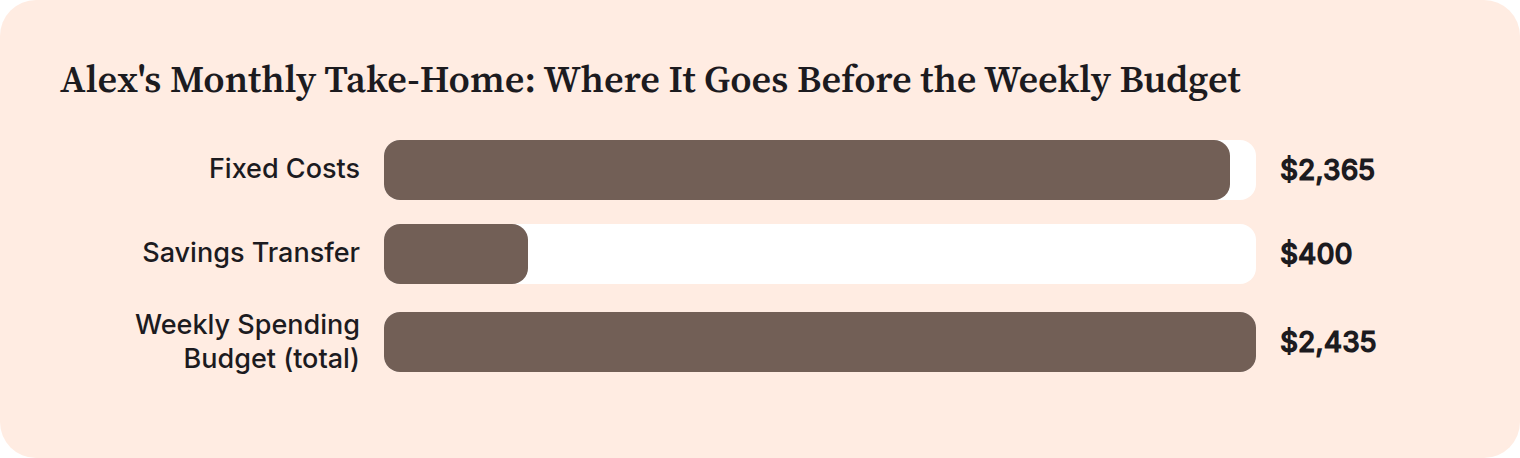
Here's how to find it. Take your monthly take-home pay. Subtract your fixed costs — rent, car payment, subscriptions, anything that hits automatically. What's left is your flexible spending pool. Divide that by 4.3 (the average number of weeks in a month). That's your weekly target.
You don't need to track coffee separately from groceries every single day. You just need to know, by Sunday, whether you're inside or outside that number.
A Real Example: How Sarah Caught a $43 Overspend Before It Became a $200 Problem
Sarah earns $5,100 a month after tax. Her fixed costs run $2,600. That leaves $2,500 flexible, or about $581 per week.
On a Tuesday in week two of the month, she does a quick five-minute check (not even her Sunday review — just a glance). She notices she's already at $624 for the week, $43 over. Most of it came from three unplanned lunch pickups. Not a crisis. But she can see it.
Because she saw it on Tuesday, she packed lunch Wednesday through Friday. She finished the week at $581. Dead on target. Without that Tuesday glance, she'd have added another $90 in lunches, started week three already in a hole, and probably given up on the whole thing by week four — which is exactly what used to happen.
The 20-Minute Sunday Ritual: Exactly What to Look At
Schedule this as a recurring calendar event. Sunday evening, 8pm, 20 minutes. The trigger is the calendar notification — not your mood, not remembering, not motivation. When the notification fires, you do the review.
- Open your bank app or credit card app. Pull up transactions from the last seven days. (5 minutes)
- Add up everything that wasn't a fixed cost. This is your actual weekly spend. (5 minutes)
- Compare it to your weekly target. Write down the difference — positive or negative — somewhere you'll see it. A notes app, a sticky note, anything. (2 minutes)
- Scan for the one category that surprised you most. Not all of them. Just one. (3 minutes)
- Decide one thing to do differently this coming week if you're over. One thing. Not a lifestyle overhaul. (5 minutes)
That's it. Twenty minutes. If you're under your target, you're done in fifteen. The point is not perfection. The point is awareness before it's too late to act.
Three Mistakes That Make Weekly Reviews Feel Like Punishment
- Tracking too many categories at once. If you're logging groceries, dining, gas, household, clothing, and personal care separately every week, it becomes a part-time job. Start with two categories max — food and everything else. Add granularity only when you're bored, not before.
- Reviewing when you're already stressed. Sunday night after a rough weekend is brutal. If Sunday doesn't work, pick Thursday morning or Saturday at noon. The day matters less than the consistency.
- Treating every overage like a moral failure. Going $30 over in one week is information, not a character flaw. The review exists to generate data, not guilt. If you feel shame every time you open the app, you will stop opening the app.
What to Do When You're Already Over Budget Mid-Week
Sometimes you'll check mid-week and realize you're already $80 over with three days left. Here's a three-move reset that actually works.
First, don't try to make it up all at once. Cutting spending dramatically for three days creates misery and usually leads to a rebound binge. Instead, aim to just stop the bleeding — spend at maintenance level for the rest of the week, not at punishment level.
Second, identify one specific expense you can delay until next week. Not cancel. Delay. A clothing purchase, a dinner out, a household item that can wait seven days. Moving one expense one week keeps the number honest without feeling like deprivation.
Third, note why you went over. Not to beat yourself up — to see the pattern. If it's the third week in a row you've overspent on food delivery, that's not a willpower issue. That's a structural problem worth solving, like keeping better lunch food at home or adjusting your weekly target upward to reflect reality.
How to Start This Sunday with Zero Setup
You don't need a new app. You don't need a spreadsheet template. Here's the minimum viable version you can run using only what you already have.
Open your bank's mobile app. Most of them show weekly or monthly spending summaries automatically now. If yours does, that's your number. If it doesn't, go to the transaction list, filter by the last seven days, and add up anything that wasn't rent, utilities, or a subscription.
Set your weekly target using the formula above. Write it on a sticky note and put it somewhere visible — inside a kitchen cabinet, on your bathroom mirror, wherever you'll actually see it. Then set a recurring Sunday calendar event right now, before you close this tab.
The system only works if the trigger is external. A calendar notification will fire whether you feel like reviewing or not. Your willpower won't.
I'd start with just two weeks of data before doing anything else. Two Sundays of comparing your actual spending to your weekly target teaches you more about your habits than a year of staring at pie charts. Once you know where the drift actually happens — and it's almost always one or two categories, not twelve — you can get specific. But first, just show up on Sunday.
Questions people also ask
What if my income varies each month and I can't set a fixed weekly target?
Base your weekly target on your lowest realistic monthly income, not your average. When you earn more in a given month, treat the extra as a deliberate allocation — savings, debt paydown, or a specific want — rather than expanding your baseline spending. This keeps the review consistent even when income isn't.
Do I need to include credit card spending in my weekly total?
Yes, absolutely. The biggest trap is tracking only what leaves your bank account and ignoring what's accumulating on a card. Pull both. If your bank and credit card are different institutions, check both apps during your Sunday review. It adds two minutes and prevents the most common blind spot.
How do I handle irregular big expenses like car repairs or annual subscriptions?
Keep a simple running list of known irregular expenses and estimate a monthly average. A $600 car repair happens roughly once a year, so budget $50 a month toward it as a fixed cost before calculating your flexible pool. When the expense hits, it doesn't blow up your weekly target.
I share finances with a partner. How do we do this together without it becoming an argument?
Keep the review short and focused on numbers, not decisions. Agree on the weekly target together before the first review, so the Sunday session is just a comparison, not a negotiation. If something needs a real conversation, schedule it separately from the review itself.
How long before this actually changes my spending habits?
Most people start catching drift in week two and making real adjustments by week three. The habit itself usually feels automatic by week six or seven — about the same time it stops feeling like a chore and starts feeling like just checking the weather.
The Full Guide
Stop Overspending Forever With a 20-Minute Weekly Money Review

- A pre-built weekly review template with your spending target already formatted — just fill in your numbers
- Three worked scenarios showing exactly how to handle a mid-week overspend, a variable-income month, and a shared household budget
- A one-page category cheat sheet showing which expenses to watch first based on the most common overspending patterns